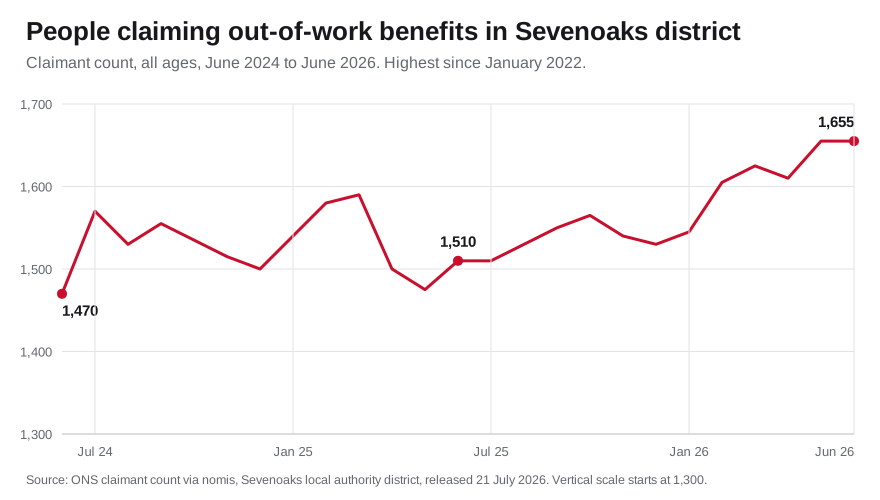

1,655 people in the Sevenoaks district claimed out-of-work benefits in June, 145 more than a year earlier. The 2.3 per cent rate is below Kent and Britain.
The number of people in the Sevenoaks district claiming unemployment-related benefits reached 1,655 in June, its highest level since January 2022, according to figures the Office for National Statistics released on 21 July. That is 145 more than the 1,510 recorded in June last year, a rise of about 10 per cent, and level with May. (ONS, Claimant count by sex and age, Sevenoaks, via nomis)
The last month with a higher figure was January 2022, at 1,705, when the district was still working through the tail of the pandemic. The count has been climbing steadily since a low of 1,355 in August 2023. (ONS, Claimant count by sex and age, Sevenoaks, via nomis)
Where Sevenoaks sits against everywhere else
The count on its own says little without the population behind it. Measured as a share of residents aged 16 to 64, the Sevenoaks district rate in June was 2.3 per cent. That compares with 3.4 per cent across Kent, 3.1 per cent across the South East and 3.9 per cent across Great Britain. A year earlier the district was on 2.1 per cent while the national figure was the same 3.9 per cent. (ONS, Claimant count by sex and age, Sevenoaks, Kent, South East and Great Britain, via nomis)
| Area | June 2025 | June 2026 |
|---|---|---|
| Sevenoaks district | 2.1% | 2.3% |
| Kent | 3.3% | 3.4% |
| South East | 3.1% | 3.1% |
| Great Britain | 3.9% | 3.9% |
So the district remains one of the easier labour markets in the county, at roughly two thirds of the Kent rate and well under the national one. What has changed is the direction. Sevenoaks moved up 0.2 percentage points over the year while the South East and Great Britain figures did not move at all, so the gap between the district and the wider region narrowed slightly rather than widened.
Young people account for a large share of the rise
The sharpest movement is at the youngest end. Claimants aged 16 to 24 in the district numbered 275 in June, against 220 a year earlier. That is 55 more young claimants, a rise of about a quarter, and it accounts for well over a third of the district’s total increase of 145. (ONS, Claimant count by sex and age, Sevenoaks, via nomis)
The split by sex in June was 885 men and 770 women. (ONS, Claimant count by sex and age, Sevenoaks, via nomis)
What this figure is, and what it is not
The claimant count is easy to misread, so it is worth being precise. The ONS is blunt about it in its own quality note: “The Claimant Count does not measure unemployment.” It counts people claiming benefits for unemployment-related purposes, drawn from Department for Work and Pensions administrative records, and it is made up of people receiving Jobseeker’s Allowance plus Universal Credit claimants who fall in the “searching for work” conditionality group. (ONS, Claimant count Quality and Methodology Information)
That has two consequences worth holding on to. It misses people who are out of work but cannot claim, including most 16 and 17 year olds, most full-time students, people over state pension age and people looking only for part-time work. And because Universal Credit conditionality is about being required to look for work rather than about having no job at all, the count is not a clean headcount of people with no earnings. (ONS, Claimant count Quality and Methodology Information)
It is still the most timely local jobs indicator there is. Survey-based unemployment rates are not published monthly for a district the size of Sevenoaks; this is, and it lands within weeks of the month it covers. Every district-level figure ONS publishes in this series is given to the nearest five, so treat small month-to-month moves with care and watch the direction over a year rather than the last data point.
What it means for you
If you have lost work or your hours have been cut, the district council runs the local end of the safety net even though the benefits themselves are national. Council tax reduction is administered by Sevenoaks District Council, and there is a separate exceptional hardship fund for people whose reduction still leaves them unable to pay. Both are applied for through the council rather than through the Department for Work and Pensions. (Sevenoaks District Council, Appeal a decision: council tax reduction and exceptional hardship payment)
If you want to check the numbers for yourself rather than take ours, the whole series is free and open. The ONS publishes it through nomis, where you can pick the Sevenoaks district, any month back to the 1990s and breakdowns by age and sex, and export it as a spreadsheet. The next monthly update, which will carry the July figures, is due on 18 August. (ONS, Claimant count by sex and age, via nomis)
For the wider picture of household costs in the district, our guide to council tax bands sets out the 2026/27 charge for every band and how the bill splits between the county council, the district, police, fire and your parish, and our page on Sevenoaks house prices tracks what homes are actually selling for.
Sources
- ONS, Claimant count by sex and age (dataset NM_162_1), Sevenoaks local authority district, via nomis. Figures released 21 July 2026; next update 18 August 2026
- ONS, Claimant count Quality and Methodology Information
- Sevenoaks District Council, Appeal a decision: council tax reduction and exceptional hardship payment
Chart by Sevenoaks Online, drawn from the ONS claimant count series for the Sevenoaks local authority district via nomis.
Have your say