
23 of the 30 applications at Sevenoaks planning committee this year got there by councillor call-in. From 31 October that route is gone. What changes for you.
Sevenoaks district councillors can no longer call in a planning application to be decided in public at committee. National rules that took effect on Saturday 31 October end the practice in every council in England.
It is a big change here. Of the 30 applications Sevenoaks District Council’s Development Management Committee considered this year, 23 reached it because a ward councillor called them in. That is our count from the officer reports for every application on the committee’s agendas between 8 January and 15 October.
What changed on Saturday
The rules are the Town and Country Planning (Discharge of Local Planning Authority Functions) (England) Regulations 2026. The government’s statutory guidance says they came into force on 31 October 2026 (Ministry of Housing, Communities and Local Government, planning committees guidance).
They split applications into two lists.
Schedule 1: officers must decide. These include:
- householder applications, such as extensions and loft conversions
- minor commercial development
- one to nine homes on a site smaller than half a hectare
- permission in principle
- prior approvals, discharge of conditions and certificates of lawfulness
- reserved matters on outline permissions below 500 homes
Schedule 2: officers decide unless two people agree otherwise. These include larger housing and commercial schemes, listed building consent, advertisement consent and works to protected trees.
A Schedule 2 application can go to committee only if it passes one of two tests. It must raise an economic, social or environmental issue “of significance to the local area”. Or it must raise a significant planning matter under the local plan.
Two people decide that: the council’s nominated planning officer and a nominated councillor. The guidance says the councillor should be the committee chair. In Sevenoaks that is Cllr Simon Reay (Sevenoaks District Council, committee membership). If the two disagree, officers decide. The guidance says referral should happen “only exceptionally”.
The guidance is blunt about the old habits. Ward councillors’ power “to require cases to be called in” and referral triggers based on objection numbers “will not be possible”. A committee decision on a case that should have gone to officers may be challenged by judicial review and quashed.
There is a separate route for “own-interest” applications. These are applications made by the council, or by one of its councillors or officers. They can still go to committee if the nominated officer and councillor agree.
How the committee’s year would have looked
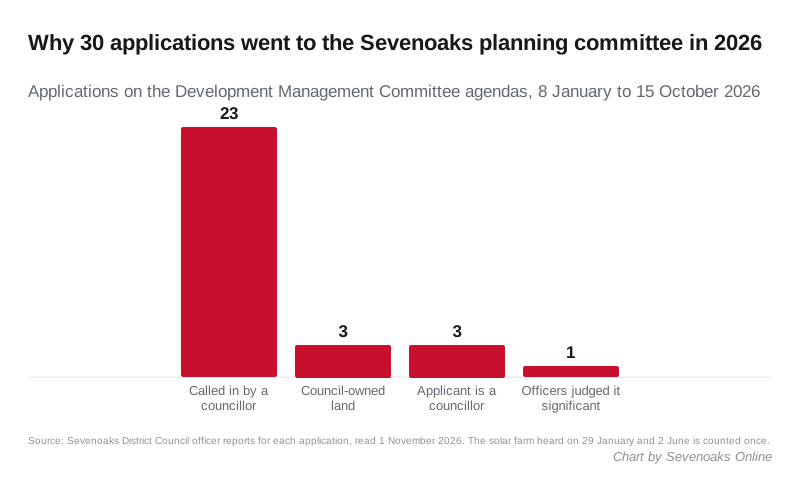
Each officer report says why the application came to committee. Across the 30 this year (Sevenoaks District Council, Development Management Committee meetings):
- 23 were called in by a ward councillor
- 3 were there because the site included council-owned land, such as the Bradbourne Lakes desilting scheme
- 3 were there because the applicant was a district councillor
- 1, the solar farm near New Ash Green, went because officers judged it “significant, controversial or sensitive”
Cllr John Grint, who represents Halstead, Knockholt and Badgers Mount, made six of the call-ins. They included the Broke Hill golf course scheme.
Under the new rules, at least eight of the 23 call-ins would have been decided by officers, with no route to committee at all:
- five householder applications: 26 Vine Court Road and 11 Crawshay Close in Sevenoaks, Mapledene on Otford Lane in Halstead, 22 Shoreham Lane in Riverhead and Lulworth on School Lane in Seal
- two permissions in principle: a home at Killaloe, Knockholt Road, Halstead, and up to nine homes at Church End, Ash Road, Ash
- two homes on stables land west of Tippuk, Packhorse Road, Bessels Green, on a site of about 0.47 hectares
Several more call-ins were single new houses on garage or garden plots. Those would also be officer-only if the site is under half a hectare. The reports do not give every site area, so we have not counted them.
The big refusals
This autumn the committee refused two schemes its officers had recommended for approval. Both reached it by call-in.
- Broke Hill, Halstead. Cllr Grint called in the 660-home outline application, 25/02129/OUT. Councillors resolved to refuse it on 24 September (our report).
- Troy Lane, Edenbridge. Cllrs Baker and Morgan called in the Gypsy and Traveller pitches, 25/02693/FUL. Councillors refused them on 15 October (our report).
From now on neither could be called in. Each could reach committee only if the nominated officer and Cllr Reay agreed it passed one of the tests. The guidance’s own example of a significant case is an outline application for a large housing scheme allocated in the local plan. The officers’ report says Broke Hill is proposed as a major site allocation under policy ST5 of the council’s draft Local Plan.
A smaller committee, and Broke Hill again
The rules also cap planning committees at 13 councillors. The agenda for the committee’s 15 October meeting listed 19 members. The agenda for its next meeting, on Thursday 5 November, lists 13 (Sevenoaks District Council, agenda for 5 November).
Six councillors on the October list are not on the November one: Cllrs Perry Cole, Granville, Hogarth, Cathy Morgan, Shea and Thornton.
The 5 November meeting is the first under the new rules. Its only application item is Broke Hill, under the heading “Call In Inquiries”. The agenda recommends that press and public be excluded for it. It gives the reason as information covered by legal professional privilege. It does not say what councillors are being asked to decide.
The meeting starts at 7pm in the Council Chamber on Argyle Road and is livestreamed on YouTube.
What it means for you
- If you object to a neighbour’s extension, your objection still counts and officers must weigh it. But your councillor can no longer ask for the decision to be made in public at committee.
- If you are applying for an extension or a small scheme, an officer will decide it. A refusal can still be appealed to the Planning Inspectorate, as before.
- If a large scheme matters to you, tell your ward councillor. They can still press the chair and the planning officer to refer it, but those two decide.
- Watch for the referral record. The guidance says councils should record which cases were considered for committee, the outcome and the reasons. It should be reported to the committee and published online.
You can comment on any live application, and check what has been submitted on your street, on the council’s planning register. Our planning applications page explains how, and our planning news page follows the district’s bigger schemes.
Sources
- Planning Committees and the National Scheme of Delegation of Planning Functions: Guidance for local planning authorities in England, Ministry of Housing, Communities and Local Government, 1 June 2026: the two schedules, the two tests, the nominated officer and member, own-interest applications, the end of call-in and objection triggers, judicial review, the referral record and the 13-member cap.
- Development Management Committee meetings, 2026, Sevenoaks District Council: the officer report for each application from 8 January to 15 October, read on 1 November 2026, for why each went to committee, the site details and the councillors who called them in.
- Development Management Committee membership and councillors by ward, Sevenoaks District Council: the chairman and Cllr Grint’s ward.
- Agenda for 15 October 2026 and agenda for 5 November 2026, Sevenoaks District Council: the membership lists, the Broke Hill item and the exempt information recommendation.
- Officers’ report on 25/02129/OUT, Former Broke Hill Golf Club, Sevenoaks District Council: Broke Hill as a draft Local Plan allocation under policy ST5, and Cllr Grint’s call-in.
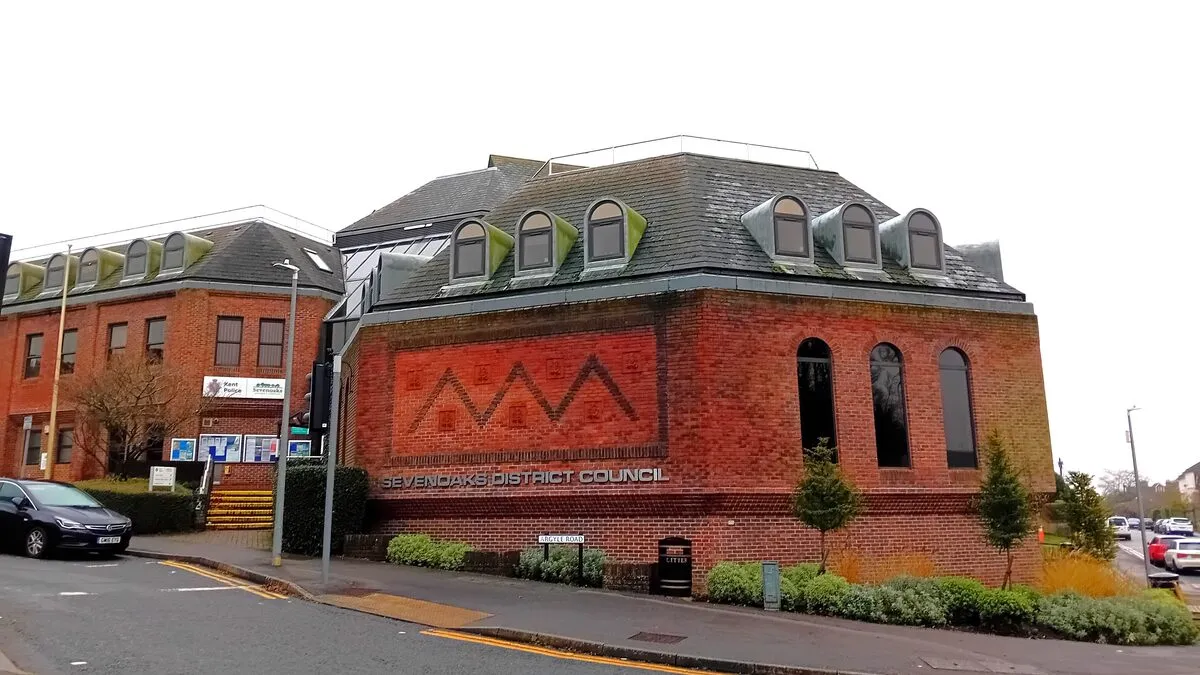
Image: “Sevenoaks District Council Offices” by Richard Kelly, CC BY 4.0, via Wikimedia Commons (https://commons.wikimedia.org/wiki/File:Sevenoaks_District_Council_Offices.jpg).
Have your say