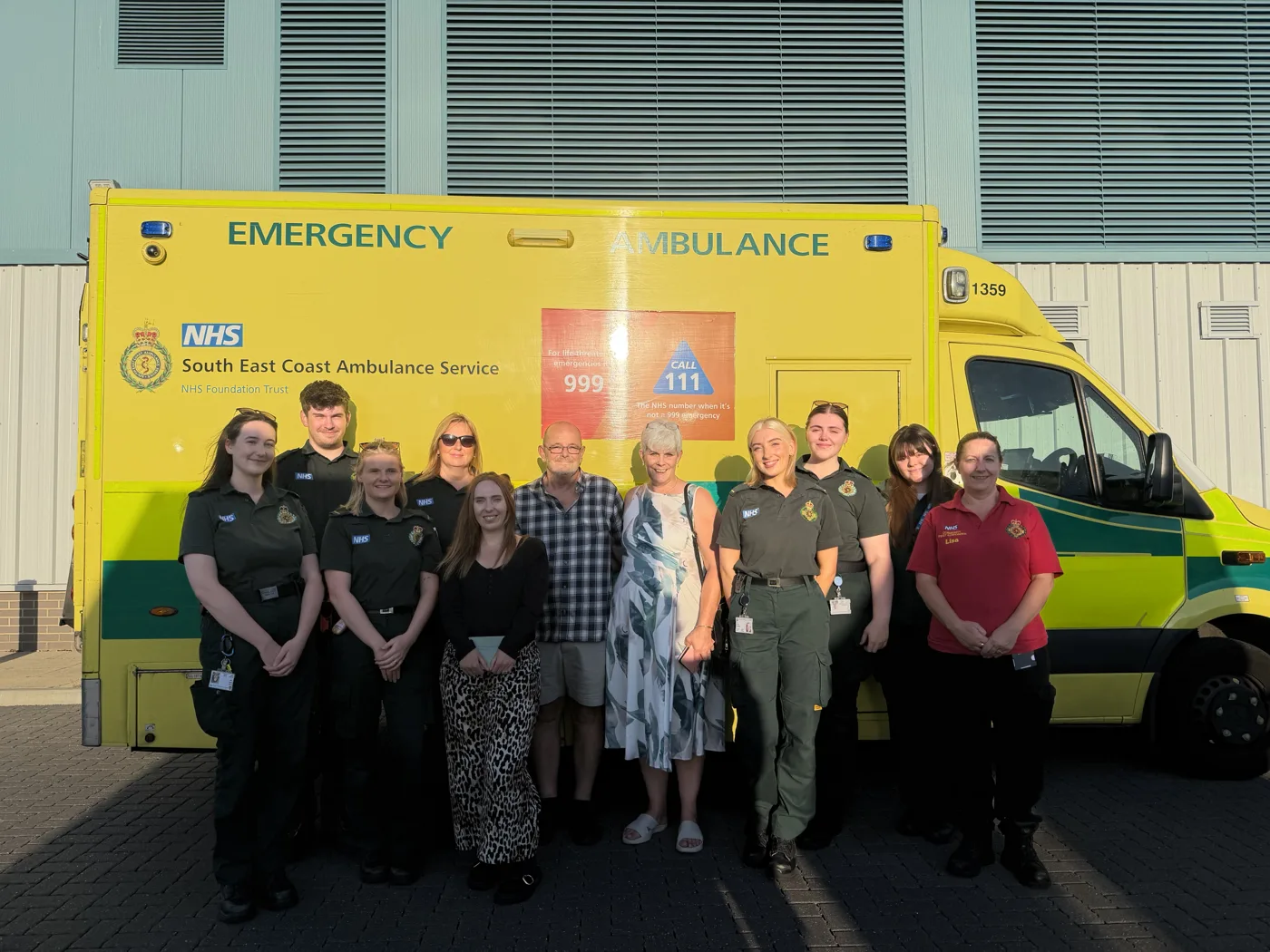

A Lordswood man whose heart stopped seven times has thanked the crews who saved him. SECAmb, which serves Sevenoaks, had its best survival month in May.
A Kent man whose heart stopped seven times on 18 May has met the ambulance crews who saved him. South East Coast Ambulance Service (SECAmb), the trust that answers 999 calls from Sevenoaks, also says May was its best month on record for cardiac arrest survival.
Rob, 59, lives in Lordswood, about 16 miles north-east of Sevenoaks. “Without all of their help the outcome could have been a different story I’m sure,” he said. “I will be forever in their debt.”
Nearly two hours at the family home
Rob was washing his car when he felt numbness in his arm and chest pain, the trust said. His wife, Sue, rang 999 straight away.
Resource Dispatchers Amie and Emily, at the Gillingham Emergency Operations Centre, sent Community First Responder Lisa to the house. Paramedic Georgia and Associate Ambulance Practitioner Jenni followed shortly afterwards. Rob went into cardiac arrest in front of them while they were assessing him with Lisa.
Paramedic Cameron and Associate Ambulance Practitioner Grace joined the resuscitation. So did Critical Care Paramedic Chris, who gave an anaesthetic bundle to support Rob’s recovery and help protect his brain.
The six restarted his heart, but it stopped a further six times. Crews kept treating him at the scene until, nearly two hours after Sue’s call, his heart held a regular rhythm. He was then taken to William Harvey Hospital for emergency surgery to remove a blockage from an artery.
“A great feeling”
Recovery was not simple. Within a month of leaving hospital Rob had chest pains and crews were called again. Associate Ambulance Practitioner Holly and Paramedic Lucy attended, and he went to Medway Maritime Hospital for further care.
Ten weeks after the cardiac arrest, he went to the trust’s Medway Make Ready Centre. There he thanked Lisa, Georgia, Jenni, Cameron, Grace, Holly, Lucy, Amie and Emily in person. Rob has little memory of what they did, so he heard it from them, and they heard how he had got on since.
“Seeing Robert walk into the room was a great feeling,” Cameron said. “Considering the last time I saw him he was post cardiac arrest and still suffering from a heart attack, Robert’s outcome demonstrates how vital early recognition, early CPR, early defibrillation and rapid transfer to advanced care are to a patient’s survival in cardiac arrest. This incident is a prime example that shows how good interagency working and strong teamwork provides the absolute best outcome for our patients.”
The record, and what it covers
SECAmb says 17.2 per cent of its cardiac arrest patients in May were alive 30 days later. Its previous best was 15.9 per cent, in June and August 2023.
NHS England’s ambulance figures bear that out. They show 40 survivors from 233 patients, the highest rate of any ambulance service in England. London was next at 12.3 per cent, and the England figure was 10.2 per cent.
One month can move a long way on numbers this small. The same data has SECAmb at 14.2 per cent in April and 10.7 per cent in January.
These are figures for the whole trust, which covers Kent, Medway, Surrey, Sussex and parts of north-east Hampshire. The published data has no separate survival rate for Sevenoaks. The trust’s five-year strategy aims to raise cardiac arrest survival by 5 per cent by 2029.
How long the wait is around Sevenoaks
What we do have for this area is how long the most urgent calls wait. SECAmb gave Sevenoaks Online postcode figures under the Freedom of Information Act last month.
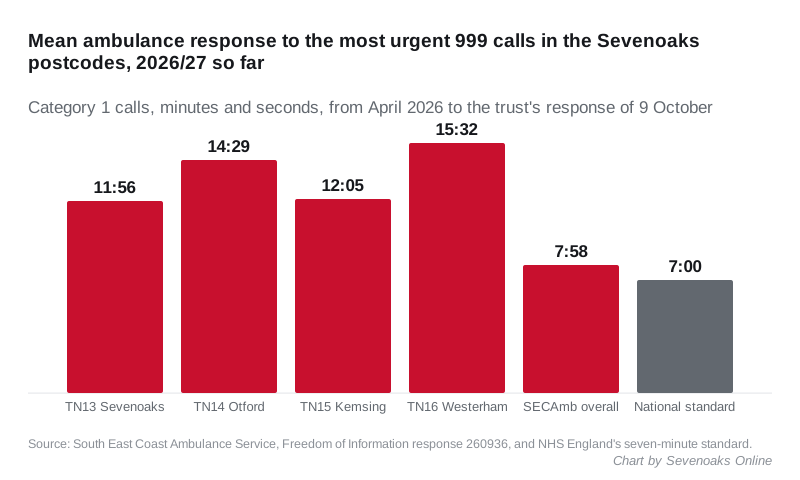
For category 1 calls, from April 2026 to the date of its response on 9 October, the mean response was:
- TN13 (Sevenoaks town): 11 min 56 sec
- TN14 (Otford, Shoreham, Halstead): 14 min 29 sec
- TN15 (Kemsing, Seal, Borough Green): 12 min 5 sec
- TN16 (Westerham, Brasted): 15 min 32 sec
- SECAmb overall: 7 min 58 sec
The national standard is a mean of seven minutes. Response times are not survival rates, and these figures say nothing about how any patient in the area fared.
What it means for you
SECAmb says the chance of survival falls by about 10 per cent for every minute someone stays in cardiac arrest without CPR and defibrillation. Its CPR page says most cardiac arrests outside hospital happen in the home. So the first person to help may well be someone in the house.
With waits like those above, that person could be on their own for some minutes. The same page sets out what you can do now:
- Learn in person, free. SECAmb trains anyone in the South East. Use the form on its CPR page or email cpr@secamb.nhs.uk.
- Learn online in about 15 minutes. The British Heart Foundation’s free RevivR tool is linked from the same page.
- Help others. The page explains how to become a community first responder, Lisa’s role when she reached Rob, and how to sign up to GoodSAM.
- Get support afterwards. It also lists help for survivors, supporters and bystanders.
SECAmb’s Kent awards last week honoured a pub landlord who gave eight minutes of CPR in the rain. It also recently thanked a four-year-old who helped on her mum’s 999 call.
Have your say