
Life-threatening 999 calls in Westerham and Otford postcodes waited 14.5 minutes on average last year, twice the standard. The figures for TN13 to TN16, by year.
An ambulance took an average of 14 minutes 36 seconds to reach the most serious 999 calls in the TN16 postcode district last year. That is more than twice the national standard of seven minutes.
The figures were released to Sevenoaks Online by South East Coast Ambulance Service NHS Foundation Trust (SECAmb) under the Freedom of Information Act. They cover the four postcode districts that take in Sevenoaks town and most of the villages around it, TN13 to TN16, from April 2023 to date. The trust’s response, reference 260936, is dated 9 October 2026.
Every one of the four was slower than the trust’s own average, in every year, for both of the most urgent categories of call.
What the categories mean
SECAmb sorts 999 calls into four categories. The two covered here are the most urgent. (South East Coast Ambulance Service, Response time targets)
- Category 1 is for “immediately life-threatening and time critical injuries and illnesses”. The standard is a mean of seven minutes, with nine calls in ten reached within 15 minutes.
- Category 2 is for other emergency calls. Stroke patients fall into this category. The standard is a mean of 18 minutes, with nine in ten reached within 40 minutes.
The trust says NHS England has “currently adjusted” the category 2 target to a mean of 30 minutes, as part of its plan to recover urgent and emergency care. The 7, 15, 18 and 40-minute standards are set out in NHS England’s ambulance data specification. (NHS England, AmbSYS specification, January 2025)
The most serious calls: category 1
In 2025/26, the last complete financial year, the mean response to a category 1 call was:
| Postcode district | Calls | Mean | 9 in 10 reached within |
|---|---|---|---|
| TN13 (Sevenoaks town) | 219 | 12 min 18 sec | 21 min 28 sec |
| TN14 (Otford, Shoreham, Halstead) | 119 | 14 min 32 sec | 22 min 23 sec |
| TN15 (Kemsing, Seal, Borough Green) | 239 | 12 min 44 sec | 19 min 27 sec |
| TN16 (Westerham, Brasted) | 79 | 14 min 36 sec | 23 min 54 sec |
| SECAmb trust-wide | 8 min 17 sec | 15 min 24 sec |
Across the trust’s whole area the mean was 8 minutes 17 seconds, still outside the seven-minute standard. In the Sevenoaks postcodes it was between four and six minutes longer.
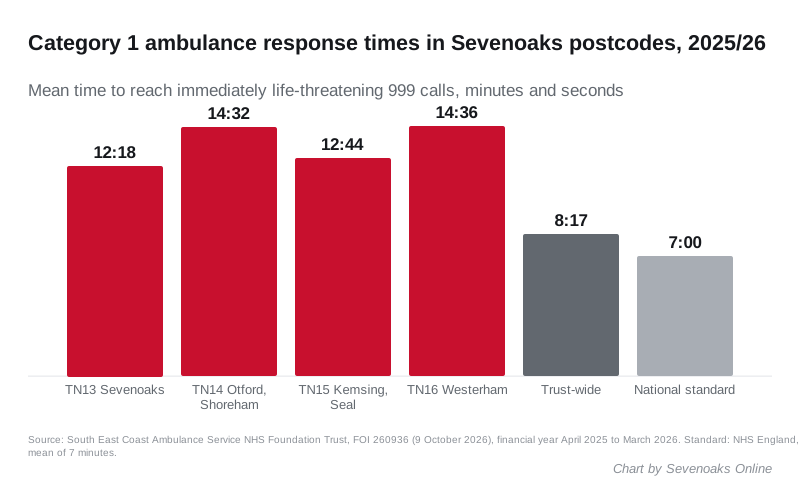
TN16 has had the slowest category 1 mean of the four in every year of the figures. It has not dropped below 14 and a half minutes in any of them.
Emergencies such as strokes: category 2
Category 2 calls are far more common. The trust attended 5,093 of them in the four postcode districts in 2025/26, against 656 category 1 calls.
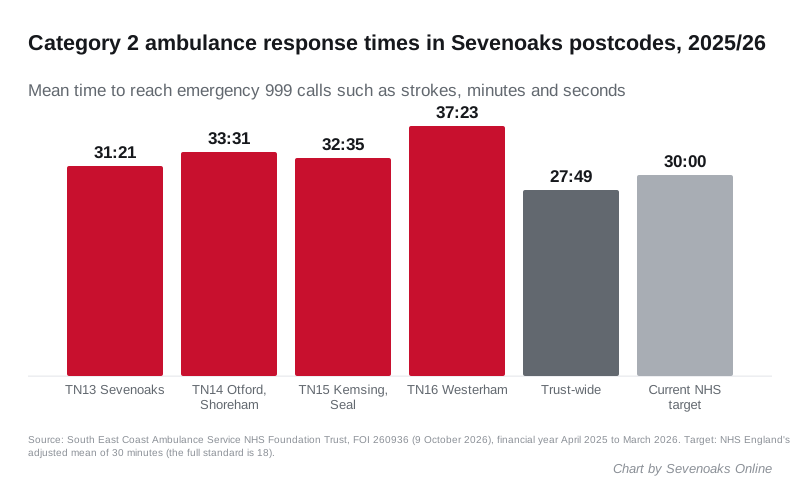
The mean category 2 response in 2025/26 was:
- TN13: 31 min 21 sec
- TN14: 33 min 31 sec
- TN15: 32 min 35 sec
- TN16: 37 min 23 sec
- Trust-wide: 27 min 49 sec
So the trust as a whole met NHS England’s adjusted 30-minute target last year. None of the four Sevenoaks postcode districts did. All four were close to double the full 18-minute standard, and TN16 was more than double it.
For nine in ten category 2 calls, the wait in 2025/26 was up to:
- 56 min 3 sec in TN13
- 60 min 31 sec in TN14
- 56 min 42 sec in TN15
- 65 min 3 sec in TN16
The trust-wide figure was 56 minutes 11 seconds. The standard is 40 minutes.
This year so far
The trust also gave figures for 2026/27 to date, from April. They are better in most places.
The category 2 mean in TN13 has fallen to 27 min 53 sec and in TN15 to 28 min 31 sec, both inside the 30-minute target. TN14 (31 min 8 sec) and TN16 (33 min 16 sec) are still outside it. The trust-wide mean so far is 27 min 26 sec.
For category 1, TN13 is at 11 min 56 sec and TN15 at 12 min 5 sec. TN14 is at 14 min 29 sec and TN16 at 15 min 32 sec, against a trust-wide 7 min 58 sec.
The longest waits
We also asked for the single longest response in each postcode district. The trust warned that “longer response times are not indicative of typical response times”, and that waits depend on demand, where crews are and other incidents at the time.
The longest single category 2 waits were:
- 2023/24: 7 hr 36 min in TN15, and 6 hr 48 min in TN13
- 2024/25: 5 hr 17 min in TN14
- 2025/26: 3 hr 3 min in TN15
- 2026/27 so far: 3 hr 30 min in TN13
The longest category 1 response in the figures was exactly one hour, in TN13 in 2023/24. The longest in 2025/26 was 39 min 17 sec, in TN16.
Why the gap
The trust’s response does not explain the difference between the Sevenoaks postcodes and its own average. It says response times are affected by “the level of service demand at the time of the incident, the availability and location of suitable resources, and the demands of other ongoing incidents”.
What the figures do and do not cover
- The figures are by postcode district, not by council boundary. TN15 includes Borough Green and Wrotham, in Tonbridge and Malling. TN16 includes Biggin Hill, in the London Borough of Bromley, and Tatsfield, in Surrey.
- Swanley, Hextable, Edenbridge and New Ash Green have BR8, TN8 and DA3 postcodes and are not in these figures. We asked only for TN13 to TN16.
- The figures count incidents SECAmb attended. They are response times, not outcomes: they say nothing about what happened to patients.
What it means for you
In a life-threatening emergency, always call 999. The figures do not change that: a category 1 call is still answered first.
If you have had a long wait for an ambulance in the district, you can contact SECAmb’s patient experience team through the trust’s website. Our earlier FOI story on how many patients each Sevenoaks GP has covers the other end of local health care.
Sources
- South East Coast Ambulance Service NHS Foundation Trust, Freedom of Information response, internal reference 260936, dated 9 October 2026, to a request from Sevenoaks Online received 21 September 2026 (Table 1, trust-wide means and 90th centiles; Table 2, incident counts, means, 90th centiles and longest responses for TN13 to TN16, 2023/24 to 2026/27 to date). Obtained under the Freedom of Information Act 2000.
- South East Coast Ambulance Service, Response time targets
- NHS England, Ambulance System Indicators (AmbSYS) specification, January 2025
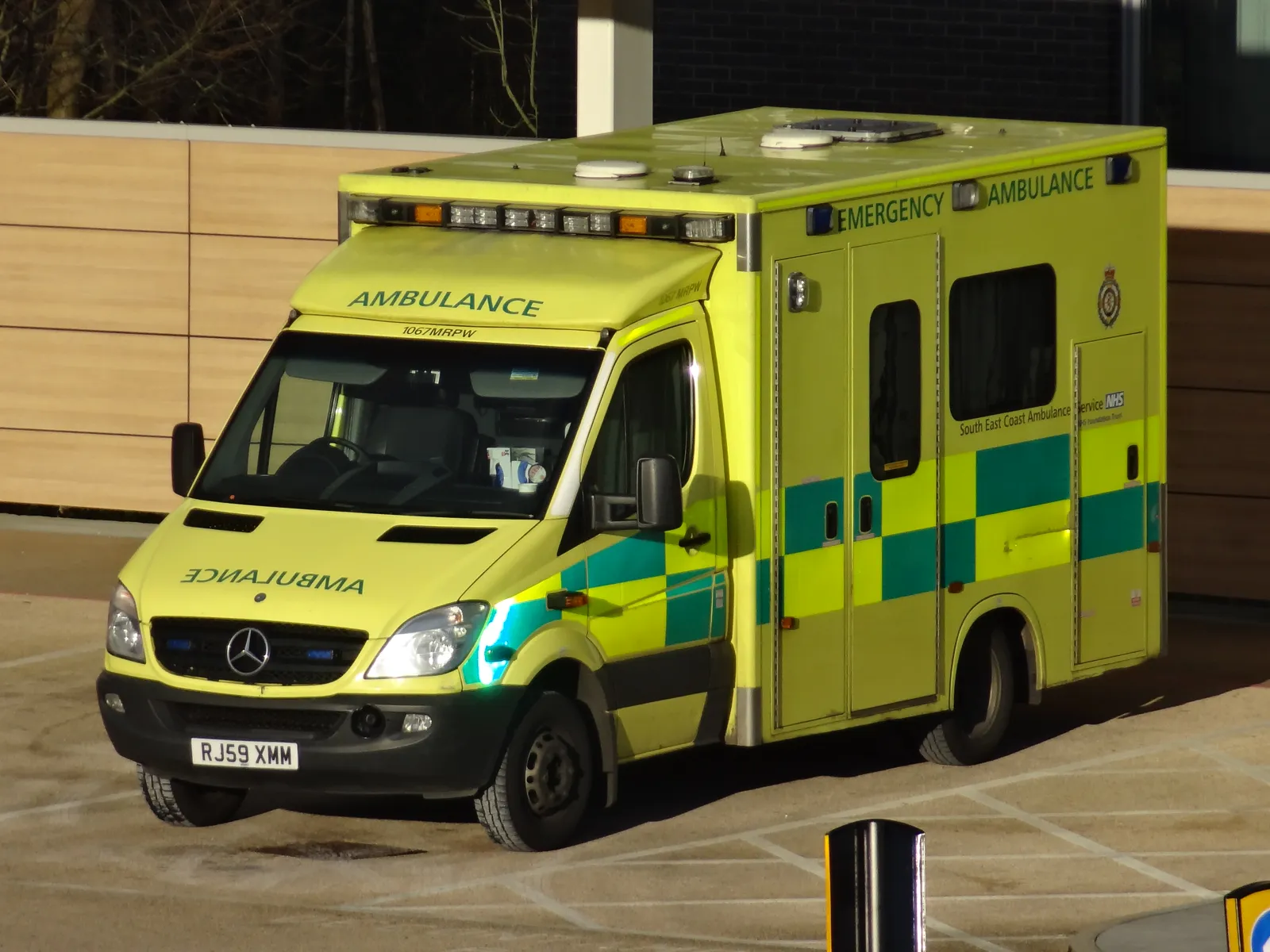
Image: RJ59 XMM, South East Coast Ambulance, by John K Thorne, CC0, via Wikimedia Commons. Charts by Sevenoaks Online.
Have your say