
Ofsted graded the Sevenoaks primary at a strong standard in all seven areas, from achievement to governance, and found safeguarding met. Published 23 July.
Ofsted has judged Lady Boswell’s Church of England Voluntary Aided Primary School in Sevenoaks to be working at a strong standard in all seven areas it now grades, and found the school’s safeguarding standards met. The report card, from an inspection on 21 April, was published on 23 July. (Ofsted, Lady Boswell’s Church of England Voluntary Aided Primary School, Sevenoaks, inspection report 21 April 2026)
The school, on Plymouth Drive in the St John’s part of town, had 435 pupils aged 5 to 11 on the day of the inspection and is run by co-headteachers Hannah Pullen and Sharon Saunders. The inspection was led by Gavin Thomas, one of His Majesty’s Inspectors, with three team inspectors. (Ofsted, inspection report 21 April 2026)
The seven grades
Ofsted no longer gives schools a single overall grade. Instead it grades separate evaluation areas on a five-point scale: exceptional, strong standard, expected standard, needs attention and urgent improvement. Lady Boswell’s was placed at strong standard in every one of them.
| Evaluation area | Grade |
|---|---|
| Achievement | Strong standard |
| Attendance and behaviour | Strong standard |
| Curriculum and teaching | Strong standard |
| Early years | Strong standard |
| Inclusion | Strong standard |
| Leadership and governance | Strong standard |
| Personal development and wellbeing | Strong standard |
| Safeguarding | Met |
Ofsted defines strong standard as a school that “reaches a strong standard” where “leaders are working above the standard expected of them”. The grade above it, exceptional, is reserved for practice “of the highest standard nationally” that other schools can learn from. (Ofsted, inspection report 21 April 2026)
On safeguarding, the report says the standards are met, meaning leaders and governors “have established an open culture in which safeguarding is everyone’s responsibility and concerns are actively identified, acted upon and managed”. (Ofsted, inspection report 21 April 2026)
What the inspectors wrote
On achievement, the report says pupils “make significant progress through the curriculum” and that their work “shows that they build securely on their learning over time”. It records that pupils “achieve very well in national tests, where results are significantly above national averages across key stages and subjects”, and that those results “have been sustained over time”. Pupils with special educational needs or disabilities “make rapid progress from their starting points”. (Ofsted, inspection report 21 April 2026)
On behaviour, the inspectors write that pupils’ behaviour “is excellent” and that “breaktimes are joyful occasions when pupils play together happily”, with bullying incidents “very rare”. Attendance “has been consistently high over time and the level of persistent absence is very low”, and the report says leaders remain “relentless in their work to improve it further”. (Ofsted, inspection report 21 April 2026)
The early years section is the most emphatic in the report: “In the early years, children receive an excellent start to their education.” Inspectors say leaders have designed “a highly ambitious curriculum”, that expert teachers deliver the phonics scheme consistently well and that “children become fluent readers swiftly”. (Ofsted, inspection report 21 April 2026)
On inclusion, the report says leaders “have the highest ambition for pupils who face barriers to success” and “work tirelessly in these pupils’ best interests”. On leadership, it records that governors “offer high levels of challenge and support to leaders” and that leaders “prioritise staff’s workload and wellbeing”. (Ofsted, inspection report 21 April 2026)
The pupil-facing section of the report card describes children working to embody the school’s “seven gifts”, key qualities such as resilience and academic excellence, and notes “the purposeful buzz in classrooms”. (Ofsted, inspection report 21 April 2026)
One thing to work on
The report gives the school a single next step: “Leaders should continue their work to embed the high-quality approach to assessment across all subjects to help pupils deepen their knowledge and understanding even further.” (Ofsted, inspection report 21 April 2026)
The numbers behind the grades
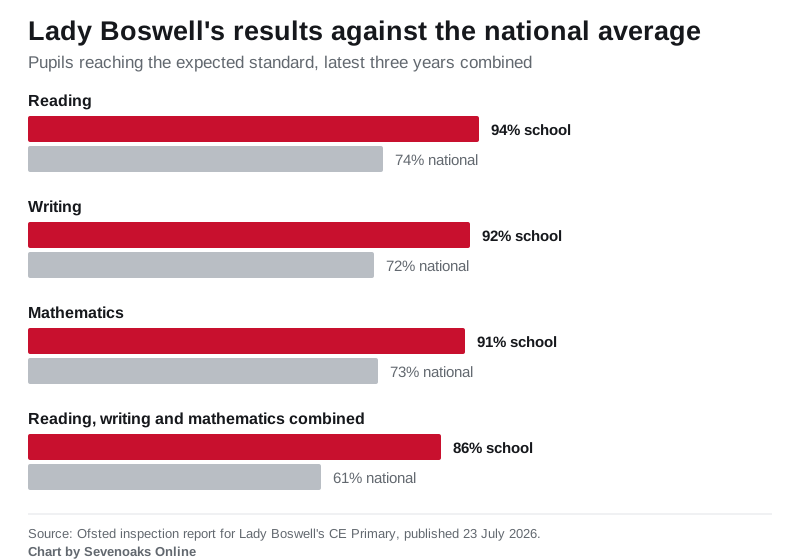
Ofsted publishes the data it used alongside the judgements. Over the latest three years, 86 per cent of Lady Boswell’s pupils reached the expected standard in reading, writing and mathematics combined, against a national average of 61 per cent. Reading was 94 per cent against 74 per cent nationally, writing 92 per cent against 72 per cent, and mathematics 91 per cent against 73 per cent. Overall absence in 2024/25 was 3.6 per cent against 5.2 per cent nationally, and persistent absence 5.0 per cent against 13.3 per cent. (Ofsted, inspection report 21 April 2026)
The same data shows a school with an unusually settled intake. It has 435 pupils against a national average of 272 for its phase, is close to its capacity of 436, and has 4.83 per cent of pupils eligible for free school meals at some point in the last six years against a national figure of 26.3 per cent. Pupils on special educational needs support make up 7.36 per cent against 15 per cent nationally, and Ofsted rates the school’s location deprivation as well below average. (Ofsted, inspection report 21 April 2026)
The report also flags where the school’s own disadvantaged pupils sit. Over three years, 57 per cent of them reached the expected standard in reading, writing and mathematics combined, above the 46 per cent for disadvantaged pupils nationally, but 10 percentage points below the figure for all non-disadvantaged pupils nationally. In mathematics alone the gap against national non-disadvantaged pupils is 23 percentage points. Ofsted still graded achievement at a strong standard and says disadvantaged pupils “make significant progress from their starting points”. (Ofsted, inspection report 21 April 2026)
Why you cannot line this up against 2022
Lady Boswell’s was last inspected on 24 and 25 May 2022, when Ofsted judged it outstanding for overall effectiveness, quality of education, behaviour and attitudes, personal development and leadership and management, and good for early years provision. (Ofsted, Lady Boswell’s Church of England Voluntary Aided Primary School, Sevenoaks, inspection report 24 to 25 May 2022)
Those grades came from a framework that no longer exists. The 2026 report card carries no overall effectiveness judgement, uses different area names and a different five-point scale, and does not include outstanding or good as grades at all. Reading a move from outstanding to strong standard as a downgrade would be wrong, because the two scales are not measuring the same thing in the same way. The 2026 report notes that under Ofsted’s renewed framework “all inspections are now led by His Majesty’s Inspectors (HMIs) or by Ofsted Inspectors (OIs) who have previously served as HMIs”. (Ofsted, inspection report 21 April 2026)
The school has published the report card on its own website alongside its 2026 SIAMS report, the separate inspection of a church school’s religious character. It has not posted a statement about the inspection. The report card records that the school’s last section 48 inspection of religious character took place in March 2026, and that the chair of governors is Kate Phillips. (Lady Boswell’s C.E. VA Primary School, Ofsted, SIAMS, assessment results and other key information; Ofsted, inspection report 21 April 2026)
What it means for parents
If you are choosing a primary school, the report card is the document to read rather than any summary of it, including this one. Every Ofsted report for every school in the district is free to read on the Ofsted website, and each provider page also lists the previous reports so you can see how long a judgement has stood. Lady Boswell’s page is reports.ofsted.gov.uk/provider/21/118721.
Two practical points follow from the report. The first is that a strong report card does not change admissions: places at Lady Boswell’s are allocated through Kent County Council’s primary admissions round, not by the school on the strength of an inspection, and the school is close to full at 435 pupils against a capacity of 436. The second is that schools in the district are a county council responsibility rather than a district council one, the same split that decides who runs most local services. Our guide to council tax bands sets out how that division works and where the money goes.
Sources
- Ofsted, Lady Boswell’s Church of England Voluntary Aided Primary School, Sevenoaks, inspection report 21 April 2026, published 23 July 2026 (PDF)
- Ofsted, Lady Boswell’s Church of England Voluntary Aided Primary School, Sevenoaks, provider page
- Ofsted, Lady Boswell’s Church of England Voluntary Aided Primary School, Sevenoaks, inspection report 24 to 25 May 2022 (PDF)
- Lady Boswell’s C.E. VA Primary School, Ofsted, SIAMS, assessment results and other key information
Image: St Botolph’s Road, Sevenoaks by Marathon, CC BY-SA 2.0, via Geograph. The photo shows the St John’s area of Sevenoaks, not the school.
Have your say