

An Otford 11-plus tutor says two to three hours a week is plenty in Year 5, in 20 to 30 minute sessions, and names the burnout signs to act on first.
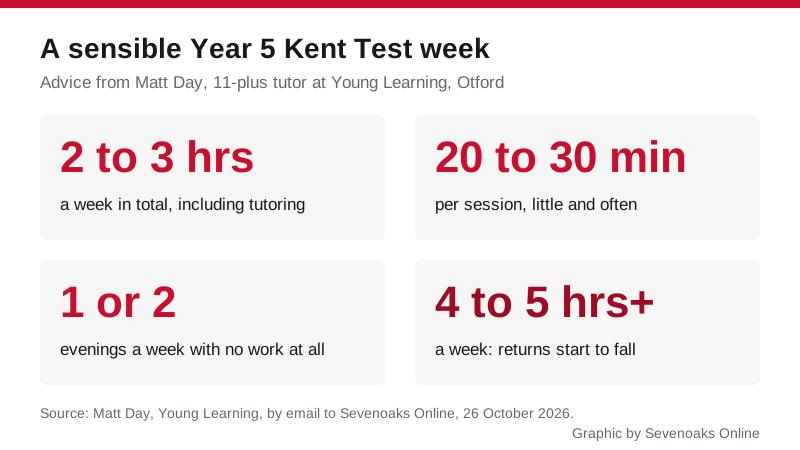
How much Kent Test practice should a Year 5 child be doing? For most children, around two to three hours a week, including any tutoring, according to Matt Day of Young Learning, an 11-plus tutor in Otford. Beyond four or five hours a week at that age, he says, the returns start to fall.
We put two questions to him for parents of children now in Year 5, the year before the test. His answers are below, at length.
The quick answer
Two to three hours a week in Year 5 is plenty, counting any tutoring, split into sessions of 20 to 30 minutes rather than one long weekend sitting. More than four or five hours a week tends to backfire. The first signs of burnout are behavioural, not academic: tears at practice time, headaches or stomach aches on practice days, poor sleep, and a sudden drop in accuracy. If you see them, cut the volume and soften the tone first, and keep at least one or two evenings a week completely free of work.
How many hours is sensible?
“For most children, around two to three hours a week in Year 5 is plenty, including any tutoring,” Mr Day said. “That is best split into short, focused sessions of 20 to 30 minutes rather than one long weekend slog. Regular, little-and-often practice builds fluency and confidence far better than cramming.”
Two to three hours in half-hour sessions works out at four to six sittings a week.
“More starts to backfire when it begins to squeeze out sleep, sport, play and unstructured downtime, or when the child is doing extra work to compensate for feeling behind. Beyond four or five hours a week at this age, I see diminishing returns: tired children make careless errors, practise mistakes and start to associate learning with pressure.”
The early signs of burnout
“The early signs are usually behavioural rather than academic,” he said: “reluctance or tears when it is time to practise, headaches or stomach aches on practice days, irritability, disrupted sleep, a sudden drop in accuracy on topics the child previously handled well, and a loss of interest in hobbies and friends.”
That last academic sign is worth separating out. A child who suddenly gets wrong the kind of question they used to get right is not necessarily short of practice; on Mr Day’s account, it can mean they have had too much.
What to change first
“The first thing to change is the volume and the tone, not the target,” he said. “Cut the hours back, shorten the sessions, and protect at least one or two completely work-free evenings. Swap some formal papers for lighter activities such as puzzles, reading and mental maths games. Praise effort and progress rather than scores, and remind your child that the test is one route among several, not a verdict on them.”
One route among several
That last point holds locally. The Kent Test is three papers, English, maths and reasoning, and this year a child needed a total of 345 with no single score below 111 to be assessed suitable for grammar school. Kent County Council’s own Kent Test guidance describes grammar schools as catering for roughly the top quarter of the ability range, so most Sevenoaks children go on to a non-selective school, and the county form lets every family name four schools. A result that is not a grammar assessment does not stop you naming a grammar school either: the preference is refused on offer day, and that refusal carries a right of appeal.
Our Sevenoaks secondary school places page has the deadlines and last year’s offers at each local school. For this year’s Year 6, the county form closes on Monday 2 November 2026 and offers go out on Monday 1 March 2027.
What it means for you
If your child is in Year 5, four to six half-hour sessions a week, tutoring included, is a reasonable ceiling to start from. Watch the child rather than the scores. If practice time brings tears, aches or bad nights, take hours out before you add any more in, and keep at least one or two evenings a week free of work altogether.
Matt Day runs Young Learning, an 11-plus tutoring service in Otford. He answered our questions by email on 26 October 2026.
Have your say