
The levy consultation closed on 17 September and 24 responses are public: every objection came from a resident, while TfL and the NHS backed it.
The consultation closed at 11.59pm on Thursday 17 September and the council has published 24 of the responses. On the central question, whether the revised approach is "appropriate and justified", 16 respondents ticked a box: eight no, six yes, two unsure. All eight objections came from residents or a residents' association. Five of the six backers were public bodies or a developer's agent. Both parish councils that responded stopped short of supporting it. The detail is in the new section below, and the call to comment has been replaced with what happens next.
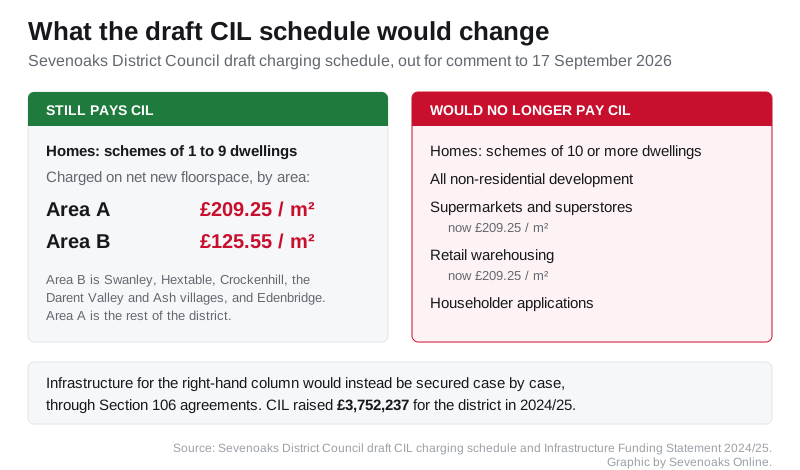
Every housing scheme of 10 or more homes in the Sevenoaks district would stop paying the Community Infrastructure Levy under a draft charging schedule the council consulted on over the summer. So would every supermarket, warehouse and office, and every householder extension. Comments closed at 11.59pm on 17 September 2026. (Sevenoaks District Council, Draft CIL Charging Schedule review)
CIL is a fixed charge in pounds per square metre, paid when building starts, on the extra floorspace a development creates. Sevenoaks District Council has charged it since 4 August 2014 and raised £3,752,237.06 from it in 2024/25 alone. (Sevenoaks District Council, Infrastructure Funding Statement April 2024 to March 2025)
The consultation opened on 6 August and ran for six weeks, ending on the same night as the Local Plan Regulation 19 consultation. The council never wrote it up on its own news pages, and one respondent says it arrived “with no warning, during the month of August and annual leave”.
What the published responses say
The council’s portal publishes only the answers of respondents who agreed to publication, and it notes that all responses are included in the analysis whether published or not. Twenty-four are up. (Sevenoaks District Council, published responses)
The form asked whether the revised approach, Section 106 for major development and CIL for small residential schemes, is appropriate and justified. Sixteen respondents ticked a box: six yes, eight no, two unsure. On the supporting evidence, including the viability assessment, thirteen ticked a box: three yes, seven no, three unsure.
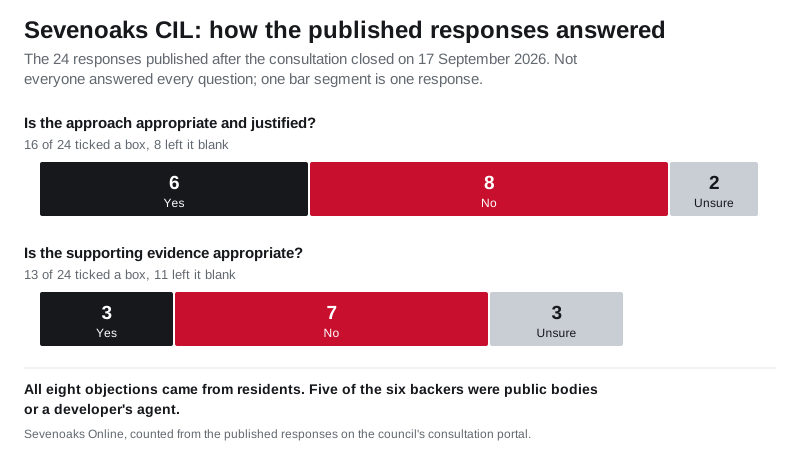
The split is not random. Every one of the eight objections came from a resident or a residents’ association. Five of the six supporters were institutions: Tunbridge Wells Borough Council, Transport for London, NHS Kent and Medway, Sport England, and James Martindale Consultancy, acting for the landowners of the EMP2-3 employment allocation at Old Otford Road. The sixth was a resident who backed the principle and then attached three conditions to it, including that no large site should pay less than it would have paid as a small one.
Three of the published responses are statutory consultees with nothing to say: the Environment Agency once, Natural England twice. Three more published nothing beyond their name.
Both parish councils stopped short
Town and parish councils are the bodies with money at stake, and two of the district’s filed.
Dunton Green Parish Council, whose village sits beside the district’s largest housing allocation, submitted a four-page paper. It accepts the council’s reasoning, then sets out the problem with it: CIL pays parishes an automatic share of every receipt, while Section 106 is negotiated between the district, the developer and the infrastructure providers, and “the consultation documents do not identify any equivalent mechanism under the proposed Section 106-led approach”. Removing major development from CIL, it says, “creates a democratic deficit unless compensating governance arrangements are introduced”.
Its conclusion is the sharpest thing in the file. The parish council “cannot support the proposed transition from a CIL-led approach to a predominantly Section 106-led approach unless clear, transparent and formal mechanisms are established to ensure parish councils have a meaningful role in influencing, monitoring and scrutinising the infrastructure obligations”. It asks the district to write a Parish and Town Council Developer Contributions Protocol, to consult parishes on draft Heads of Terms before agreements are signed, and to publish annual figures for what was secured, what was paid and what was actually built.
The same paper lists what Dunton Green is waiting on from the Infrastructure Delivery Plan: the primary school expanded from one form of entry to two at roughly £5m, station access with better lighting, CCTV and shelters, new bus links towards Bat and Ball and Sevenoaks Hospital, and cycle routes 4 and 8 from the LCWIP towards Sevenoaks and Otford.
Fawkham Parish Council ticked “unsure” and proposed a specific amendment. Where a scheme of 10 or more homes needs no Section 106 agreement because existing facilities can absorb it, CIL should still be charged: “no lower levy should be made than that which would apply to smaller developments through the payment of CIL, ie CIL should then apply. The CIL Charging Schedule should be amended accordingly.”
Swanley Village: wrong timing, wrong process, wrong solution
Bob Wallis, chair of the Swanley Village Residents’ Association, made the most detailed objection. He accepts the aims are worthy, then takes the proposal apart on three grounds.
On timing, he points at local government reorganisation: as the district “fast approaches being subsumed within the new authority tier”, its officers will be occupied by that, and the risk of failing to deliver the infrastructure “will be enormously increased”. On process, he says parish and town councils should have been in the room before the consultation, not reacting to it, and notes the consultation arrived “with no warning, during the month of August and annual leave, and clashing with the end of the Regulation 19 consultation process”.
On the solution, he makes the case concrete. “The only appreciable benefit Swanley Village has received during the 12 years I have been Chair of the Residents’ Association came through CIL funding and Swanley Town Council,” he writes, crediting it with the 20mph limit through the village. He calls the viability assessment “an inadequate, desk-based, generic report” and wants the whole thing dropped and left to the incoming West Kent authority.
The technical objection: zero-rating the biggest sites
One respondent, Harry Martin-Dreyer, argues the draft fails the legal test. Regulation 14 requires a charging schedule to strike an appropriate balance between funding infrastructure and keeping development viable, and he says exempting “the largest sources of local housing growth” fails it, leaving smaller sites to carry a district-wide fund they are least able to absorb. He also says Section 106 obligations “are frequently renegotiated post-permission on viability grounds”, so strategic sites may end up contributing less than the council expects, and he asks for an independent sensitivity test of the benchmark land values in the viability assessment.
Two Eynsford residents filed on a different worry: that taking major schemes out of CIL should not make Green Belt development look more viable than it is. Both ask the council to state plainly that the exemption creates no presumption in favour of development.
What stays in and what drops out
The draft schedule applies to one thing only: residential development creating between one and nine dwellings.
Everything below is listed in the draft as falling outside the schedule:
- residential development creating 10 or more dwellings
- all non-residential development
- householder applications
- any other development that does not create between one and nine homes
(Sevenoaks District Council, Draft CIL Charging Schedule)
Two of those are charged today. Supermarkets and superstores over 500 square metres of sales floorspace pay £209.25 per square metre, and so does retail warehousing over the same threshold. That is the Area A residential rate, and unlike homes it applies right across the district. (Sevenoaks District Council, Community Infrastructure Levy Charging Schedule, adopted February 2014)
Large home extensions are caught too. The council’s guidance tells applicants CIL “applies to residential extensions and outbuildings, supermarkets, convenience stores and retail warehousing where the proposed floor space is 100 square metres or more”. (Sevenoaks District Council, CIL guidance for planning applicants)
The rates themselves do not change
The draft schedule presents two rates: £209.25 per square metre in Area A and £125.55 per square metre in Area B. The council calls them “the updated CIL rates”. (Sevenoaks District Council, CIL Charging Schedule Review FAQs)
They are the rates already being charged. The council’s own applicant guidance lists £209.25 and £125.55 as the “2026 revised charging rates after indexation applied”, in force for permissions granted from 1 January 2026. The 2014 base rates were £125 and £75, and the RICS index used to uplift them has moved from 239 to 400.
So the price per square metre is unchanged for the homes that stay in scope. What changes is who pays at all. The council is not proposing to move the Area A and Area B boundaries either.
Area B, the lower rate, covers Swanley, Hextable, Crockenhill and Well Hill, Farningham, Horton Kirby and South Darenth, Fawkham and West Kingsdown, Hartley and Hodsoll Street, Ash and New Ash Green, and both Edenbridge wards. Area A, the higher rate, is the rest of the district, including Sevenoaks town, Otford and Shoreham, Kemsing, Eynsford, Westerham and the Weald villages.
One caution for anyone doing sums: the worked example on the council’s guidance page multiplies by £204.50, not the £209.25 in the table directly above it. Use the figure on your liability notice.
Why the council says it is doing this
The council’s case is that CIL has been good at small things and bad at big ones. Its FAQ document gives three reasons for taking major development out.
- CIL “has not generated enough funding for larger-scale strategic infrastructure”, because it is one pot stretched across the whole district
- CIL money “can be spent anywhere in the District, not necessarily in the area where specific developments take place”
- CIL payments “often need to be pooled over several years before a large project can be funded”, which delays delivery
Instead, major residential and all non-residential schemes would mitigate their impact through Section 106 agreements, negotiated site by site. The council argues these can be phased, so that a school or a junction upgrade is tied to a trigger such as “before the 50th home is occupied”, and can secure land and direct delivery rather than only cash. (Sevenoaks District Council, CIL Charging Schedule Review FAQs)
The rates have to be justified by viability evidence, which the council commissioned from Dixon Searle Partnership and published as the Local Plan and CIL Viability Assessment Stage 2 Final Report in June 2026. (Sevenoaks District Council, Local Plan and CIL Viability Assessment Stage 2 final report)
Parish councils may get less
Town and parish councils receive a share of every CIL payment made in their area. Nationally that share is 15%, rising to 25% where a neighbourhood plan is in place. Sevenoaks has been more generous since a Cabinet decision in November 2015. Every town and parish here gets the equivalent of 25% of the higher residential rate, whichever charging area the development sits in. In 2024/25 that came to £528,661.54 across the district.
The share is not changing. The pool it is drawn from is. The council’s own FAQ concedes the point directly: “this may result in reduced payments in some areas, simply because fewer developments will fall within the CIL-liable category”, and it calls the change “challenging for Town and Parish Councils”.
Its answer is that parishes should push their priorities through the Infrastructure Delivery Plan and through comments on individual planning applications, so that what they want is written into Section 106 agreements instead.
What CIL has already bought locally makes the stake concrete. The Greatness Football and Community Centre, due to be finished this month, took £787,500 of it. That was the single largest slice of the pavilion’s £2.1m cost. (Greatness pavilion: who paid for the £2.1m build)
The 2024/25 statement records these awards:
- £250,000 to the Sevenoaks Wildlife Reserve redevelopment
- £158,000 to Orchards Academy’s sports hall and facilities
- £75,000 to Sevenoaks Indoor Bowls Club solar panels
- £17,000 to West Kingsdown Village Hall car park
Since 2014, 62% of all CIL awarded has gone to community facilities, 14% to health and social care, 12% to blue and green infrastructure and 10% to highways and transport.
What it means for you
If you are planning a large extension, this matters to your budget. A householder application over 100 square metres is CIL-liable today and would not be under the new schedule. The catch is timing: nothing changes yet.
The council expects to submit the schedule for independent examination alongside the Local Plan, with adoption of both “anticipated in early 2028”. The new schedule would then apply only to planning permissions issued after that date. Anything granted between now and then pays under the current rules. (Sevenoaks District Council, CIL Charging Schedule Review FAQs)
If you live near one of the Local Plan’s larger allocations, the change decides how the infrastructure around it gets paid for. The biggest, around 1,500 homes between Dunton Green station and Otford Road, is far past the 10-dwelling threshold, so under the draft it would contribute nothing to CIL and everything through a negotiated Section 106 agreement. (1,500 homes north of Sevenoaks: what the brief promises)
What happens next
The council cannot simply adopt the schedule. Under Regulation 16 of the CIL Regulations 2010 it has to submit the draft, and every duly made comment, to an independent examiner appointed under section 212 of the Planning Act 2008, and the examination has to finish first. Anyone who wanted to be heard in person by that examiner had to ask in writing before the consultation closed, so that door shut on 17 September; comments arriving after the closing date “may not be considered”. (Sevenoaks District Council, Statement of Representations Procedure, PDF)
Submission is expected to run alongside the Local Plan, with adoption of both “anticipated in early 2028”. Until that happens nothing changes on the ground: a supermarket, a warehouse or a 150 square metre extension permitted between now and adoption still pays at the current rates.
You can check what is proposed near your own address on the council’s planning portal, and our guide to Sevenoaks planning applications explains how to search it and how to comment.
Sources
- Sevenoaks District Council, Draft Community Infrastructure Levy charges (the council page carrying the notice, removed from sevenoaks.gov.uk after the consultation closed)
- Sevenoaks District Council, Draft CIL Charging Schedule review consultation
- Sevenoaks District Council, Draft CIL Charging Schedule (PDF)
- Sevenoaks District Council, CIL Charging Schedule Review frequently asked questions (PDF)
- Sevenoaks District Council, CIL guidance for planning applicants
- Sevenoaks District Council, Community Infrastructure Levy Charging Schedule, adopted February 2014 (PDF)
- Sevenoaks District Council, Infrastructure Funding Statement April 2024 to March 2025 (PDF)
- Sevenoaks District Council, Local Plan and CIL Viability Assessment Stage 2 final report
- Sevenoaks District Council, published responses to the Draft CIL Charging Schedule Review
- Sevenoaks District Council, Statement of Representations Procedure (PDF)
- Dunton Green Parish Council, response to the Draft Community Infrastructure Levy Charging Schedule, September 2026 (PDF attached to its published response)
- Sevenoaks District Council, Consultations
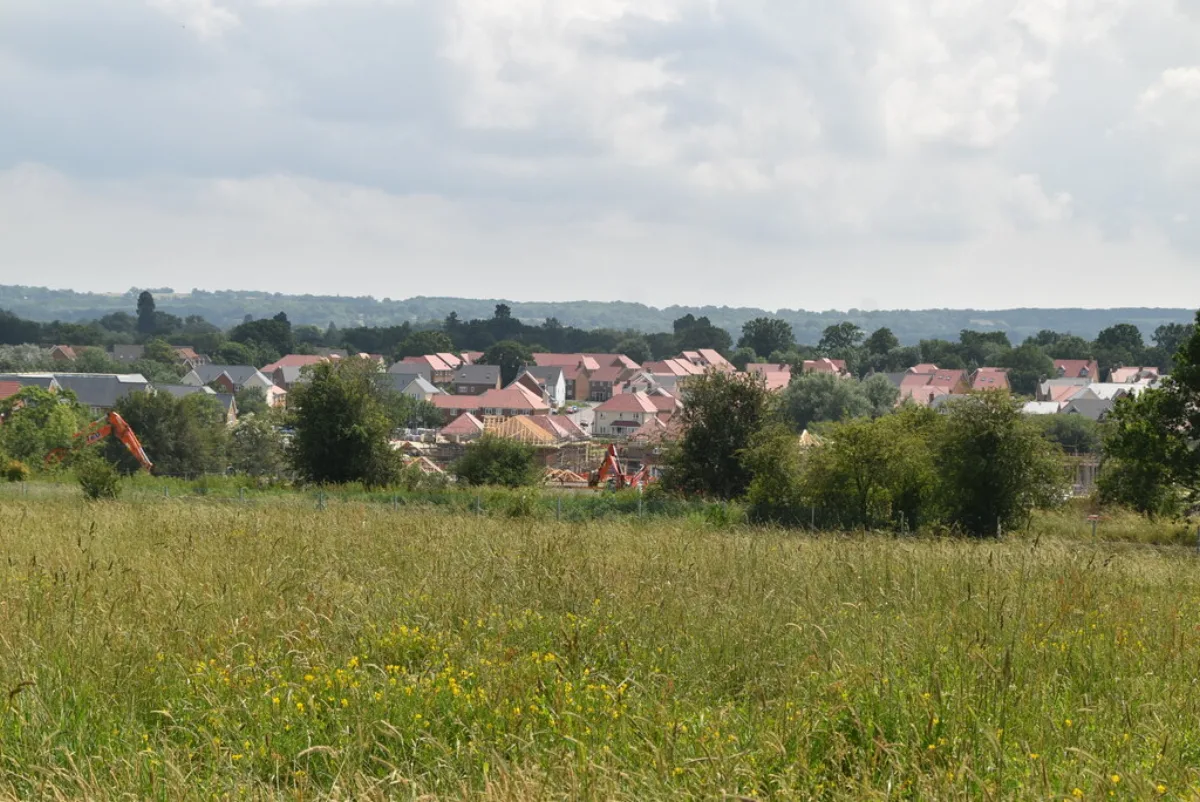
Image: New housing development by N Chadwick, CC BY-SA 2.0, via Geograph.
Have your say