

A Tunbridge Wells osteopath says the biggest desk mistake is sitting still too long, and sets out when back pain needs booking in, not self-managing.
If you sit at a desk all day and your lower back aches by the afternoon, the chair is probably not the main problem. Staying still is, according to Andre Treen of Andre Treen Osteopathy, who practises at Healthworks on Whitefield Road in Tunbridge Wells.
We put two questions to him for readers who work at a desk, in an office or at home. His answers are below.
The quick answer
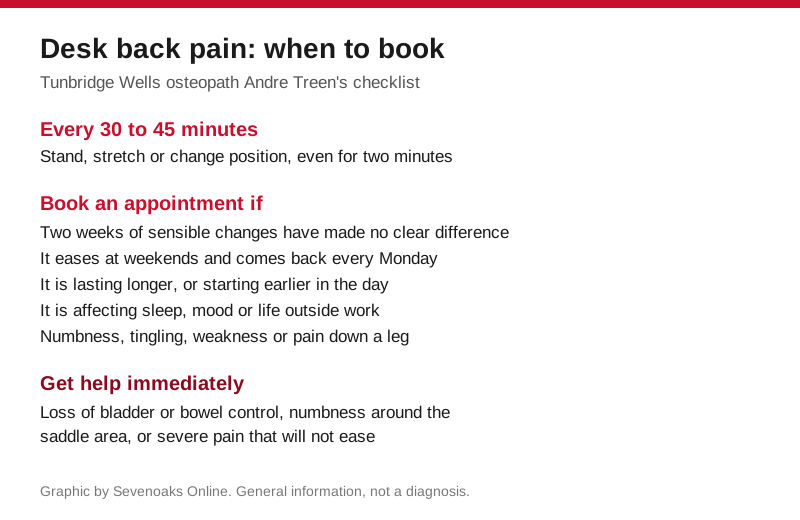
Get up or change position every 30 to 45 minutes. Two minutes of movement is enough: stand, stretch, fetch water. Book a professional appointment if two weeks of sensible changes have not made a clear difference, if the pain keeps coming back every working week, if it is getting worse, if it is affecting sleep or life outside work, or if you have numbness, tingling, weakness or pain down a leg. Loss of bladder or bowel control, numbness around the saddle area or severe unrelenting pain need immediate medical help.
The most common mistake
“The single most common mistake I see is staying in one position for too long, often 1 to 2 hours or more, without moving at all,” Mr Treen said. “People tend to focus on ‘perfect posture’ and forget that even the best posture becomes a problem if you never change it. Over time, sitting still flattens the natural curve of the lower back, tightens the hip flexors, and fatigues the supporting muscles until they ache.”
His fix costs nothing. “Stand up, move, or at least change position every 30 to 45 minutes. It doesn’t need to be exercise: just stand, stretch, walk to get water, or gently shift how you’re sitting. Two minutes of movement every half hour makes a real, measurable difference to spinal loading and muscle fatigue. Set a timer; this small habit beats almost every other desk adjustment.”
The Health and Safety Executive’s guidance on screen work points the same way. The law says employers must plan work so that people who use screens get breaks or changes of activity, and the HSE says short, frequent breaks beat longer, rarer ones: 5 to 10 minutes every hour is better than 20 minutes every two hours.
When to stop self-managing
“As a general guide, book an appointment if:
- two weeks of sensible changes, regular movement breaks, simple stretches, better setup, haven’t made a clear difference
- pain keeps coming back, for example easing on weekends but returning every Monday, or flaring up whenever you return to normal work hours
- pain is getting gradually worse, lasting longer each time, or starting earlier in the day
- it’s affecting sleep, mood, or what you can do outside work
- you notice numbness, tingling, weakness, or pain travelling down your leg. These can signal nerve involvement and are worth checking promptly.”
“Early assessment isn’t about overreacting,” he said. “It’s about stopping a short-term strain from turning into a long-term cycle of pain and compensation patterns that become harder to unwind.”
The symptoms that cannot wait
“Seek immediate medical help if you lose bladder or bowel control, have numbness around the saddle area, or develop severe unrelenting pain. These are red-flag symptoms,” Mr Treen said.
The NHS back pain page says to call 999 or go to A&E with back pain plus pain, tingling, weakness or numbness in both legs, loss of feeling around the genitals or anus, or changes in your bladder or bowels, and not to drive yourself there. It also says that in many areas you can refer yourself to NHS community musculoskeletal services, such as physiotherapy, without going through a GP.
What it means for you
Set a timer for 30 to 45 minutes and move when it goes off. Give sensible changes two weeks. If the pain has not clearly improved, keeps returning with the working week, or spreads into a leg, get it assessed rather than waiting for it to settle.
Mr Treen’s answers are general educational information, not a clinical diagnosis; he says individual cases vary and anyone with concerns should see a qualified healthcare professional.
Andre Treen runs Andre Treen Osteopathy, based at Healthworks, Whitefield Road, Tunbridge Wells. He answered our questions by email on 27 October 2026.
Have your say