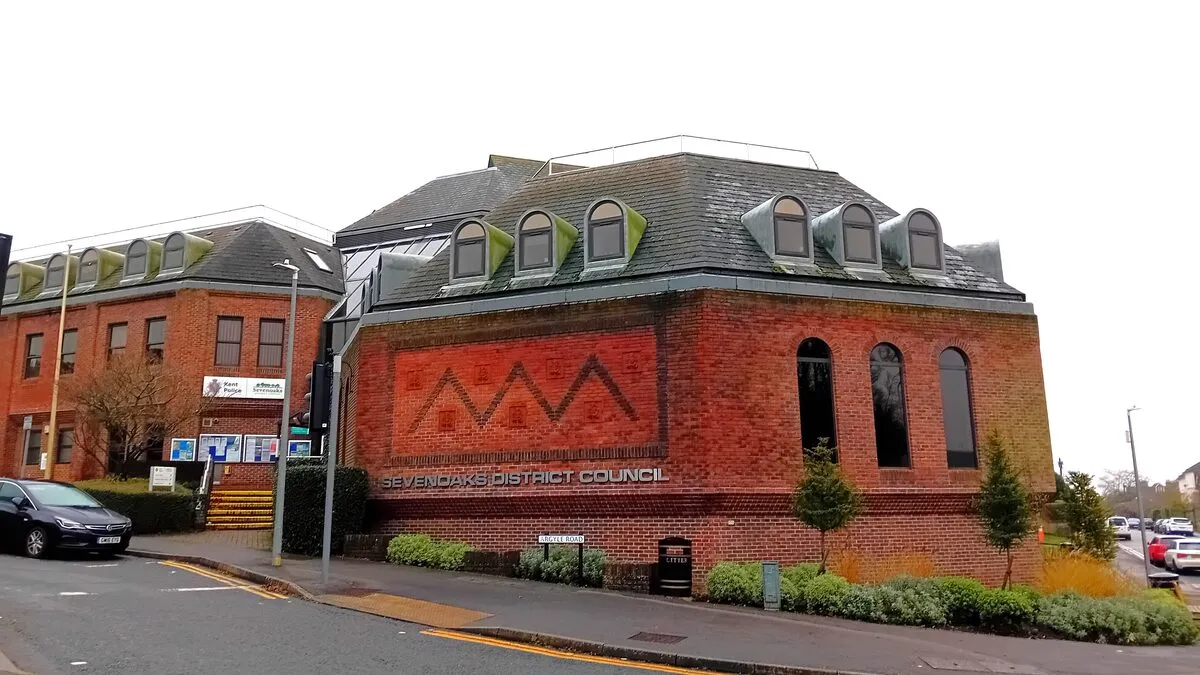

Council papers say funding projects from its own cash cannot go on: £100m of approved loans unused, £10.6m owed short term, £130,000 overspend forecast.
Sevenoaks District Council says the way it has paid for its building projects for years, out of its own cash rather than loans, “is not sustainable”. Its own borrowing update, going to councillors on Tuesday 15 September, says the council will have to take out external loans to fund its growing capital programme. (Sevenoaks District Council, Borrowing Strategy Update)
The same meeting will hear that the council’s day-to-day budget is forecast to end the year £130,000 in the red. (Sevenoaks District Council, Financial Monitoring 2026/27 to the end of July)
Both reports went to the Finance and Investment Advisory Committee at 7pm on Tuesday 15 September. They went on to Cabinet at 7pm on Tuesday 22 September, as items 7 and 8, in the Council Chamber on Argyle Road. (Sevenoaks District Council, Cabinet agenda, 22 September 2026, published 14 September)
Updated 24 September 2026: Cabinet approved the treasury management report and noted the financial monitoring report on 22 September. Officers told members there is “no longer capacity” for further internal borrowing, the £100 million of approved external borrowing remains undrawn, and the pay award has since been settled at 3.3%, £71,000 above budget. The full record of that meeting is on our Sevenoaks District Council news page.
Corrected 18 September 2026: this page previously said the Cabinet meeting had been moved to 20 October. The council published the 22 September agenda on 14 September. We had followed the council’s own meetings calendar, which still labels that Cabinet as moved.
What the borrowing paper says
For years the council has funded capital schemes from its own cash balances instead of loans, a position known as internal borrowing. That was cheap while interest rates were low. The update says the approach has now run out of road:
- running down cash balances has cut the council’s investment income
- short-term borrowing has been needed to cover cash flow at the end of recent financial years
- this year that temporary borrowing “has had to be renewed and has carried further into the new year than usual”
- external borrowing that is approved but not yet taken out, including for projects at an early stage, totals approximately £100m
The report’s own words are blunt: “The current level of internal borrowing is not sustainable and the ambitious capital aspirations of the council going forward, as set out in the capital programme, will require projects to be funded using appropriate levels of external borrowing.” Officers say they will review existing projects to look at securing borrowing against them where appropriate. (Sevenoaks District Council, Borrowing Strategy Update)
Who the council owes
The council’s long-term debt is two Public Works Loan Board loans, both for projects residents use every day. £5.25m at 2.66% funded the Sevenoaks Town Car Park, with £4.2m still owed and a final payment due in 2047. £8m at 1.70% funded the White Oak Leisure Centre in Swanley, with £6.6m owed to 2041. (Sevenoaks District Council, Borrowing Strategy Update)
On top of that, the paper lists £10.6m of short and medium-term loans outstanding at 31 March 2026:
- £2.6m from Crawley Borough Council at 4.6%
- £3m from the Teesside Pension Fund at 5.3%
- £5m from the London Treasury Liquidity Fund at 5.8%
Short-term lending between councils and public-sector funds is routine. But the rates show the problem: the money Sevenoaks borrowed short term cost roughly two to three times the interest rate on its long-term debt.
The pressure comes from the size of the building programme. The borrowing paper puts the capital programme at £25.5m for 2026/27, up from £12.1m the year before; the monitoring report puts the current year’s budget at £27.9m. Either way it is roughly double last year’s, and the paper notes that in earlier years there was “no real requirement to borrow” at all. It also defends not borrowing sooner: taking loans in advance would have been costly for schemes that were later delayed or not approved, and it names Bevan Place in Swanley as an example. (Sevenoaks District Council, Borrowing Strategy Update)
A £130,000 hole in this year’s budget
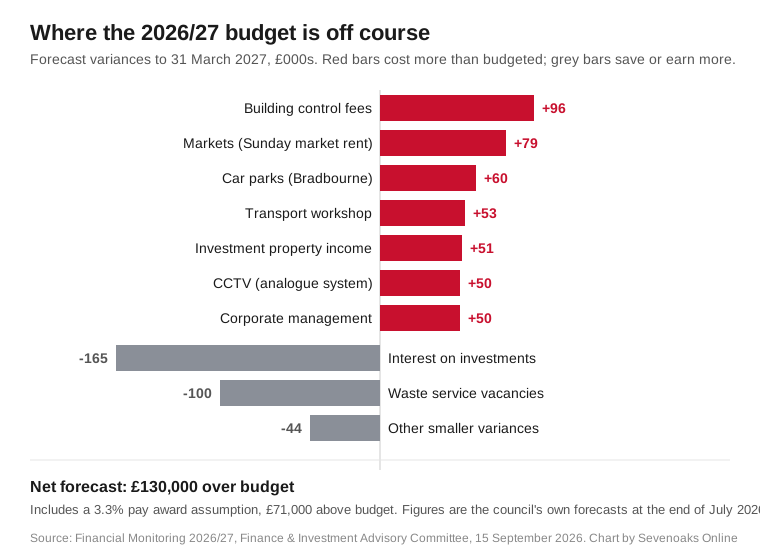
The monitoring report forecasts an unfavourable variance of £130,000 by 31 March 2027. It builds in a 3.3% pay award, the latest offer to council staff, which is £71,000 more than budgeted. (Sevenoaks District Council, Financial Monitoring 2026/27)
The biggest forecast overspends and income shortfalls are:
- £96,000 in building control, from lower fee income plus staff and contractor costs
- £79,000 from the markets, blamed on “loss of income on the Sunday Market due to the operator struggling”, partly offset by better Wednesday market takings
- £60,000 at the car parks, mainly lost day-ticket income at Bradbourne car park “due to competition”, plus lower season-ticket sales
- £53,000 at the transport workshop, from reduced income on repairs work
- £51,000 on the council’s investment properties, from extra business rates and empty or rent-free units
- £50,000 on CCTV, from the high running costs of an analogue transmission system due to be replaced
- £50,000 in corporate management, a vacancy-pot contribution shortfall
Two things pull the other way. Staff vacancies in the waste service save £100,000, and interest on the council’s investments is forecast to come in £165,000 above budget. (Sevenoaks District Council, Financial Monitoring 2026/27)
The investments are the bright spot
A third paper on the agenda, the Treasury Management Annual Report for 2025/26, shows why the council is reluctant to run its cash down further. Its investments returned £748,065 in interest last year against a budget of £532,000, a 4.43% return and £216,000 above target. (Sevenoaks District Council, Treasury Management Annual Report 2025/26)
The same report shows how much of the building programme slipped: the council spent £11.7m on capital projects in 2025/26 against a revised estimate of £20.7m. (Sevenoaks District Council, Treasury Management Annual Report 2025/26)
What it means for you
Nothing changes on your bill this year; the reports are forecasts, not new charges. But how the council funds its projects feeds directly into the budget that sets council tax each February. Interest on new loans is paid from the same revenue budget that runs bin rounds, planning and leisure services, and the short-term loans in the paper cost 4.6% to 5.8% against the 1.70% and 2.66% on the council’s existing long-term debt. The line about Bradbourne car park losing trade “due to competition” is also worth watching if you park in Sevenoaks: pricing pressure on the council’s car parks tends to surface in the next tariff review.
The committee met in public at the Argyle Road offices on Tuesday 15 September, and Cabinet takes the same reports there at 7pm on Tuesday 22 September. The full papers are on the council’s committee pages, and what it says lands at Cabinet, which now next meets on 20 October after the 22 September meeting was moved.
Sources
- Sevenoaks District Council, Borrowing Strategy Update, Finance and Investment Advisory Committee, 15 September 2026
- Sevenoaks District Council, Financial Monitoring 2026/27: to the end of July 2026, Finance and Investment Advisory Committee, 15 September 2026
- Sevenoaks District Council, Treasury Management Annual Report 2025/26, Finance and Investment Advisory Committee, 15 September 2026
- Sevenoaks District Council, Finance and Investment Advisory Committee agenda, 15 September 2026
Image: Sevenoaks District Council Offices by Richard Kelly, CC BY 4.0, via Wikimedia Commons. Chart by Sevenoaks Online.
Have your say