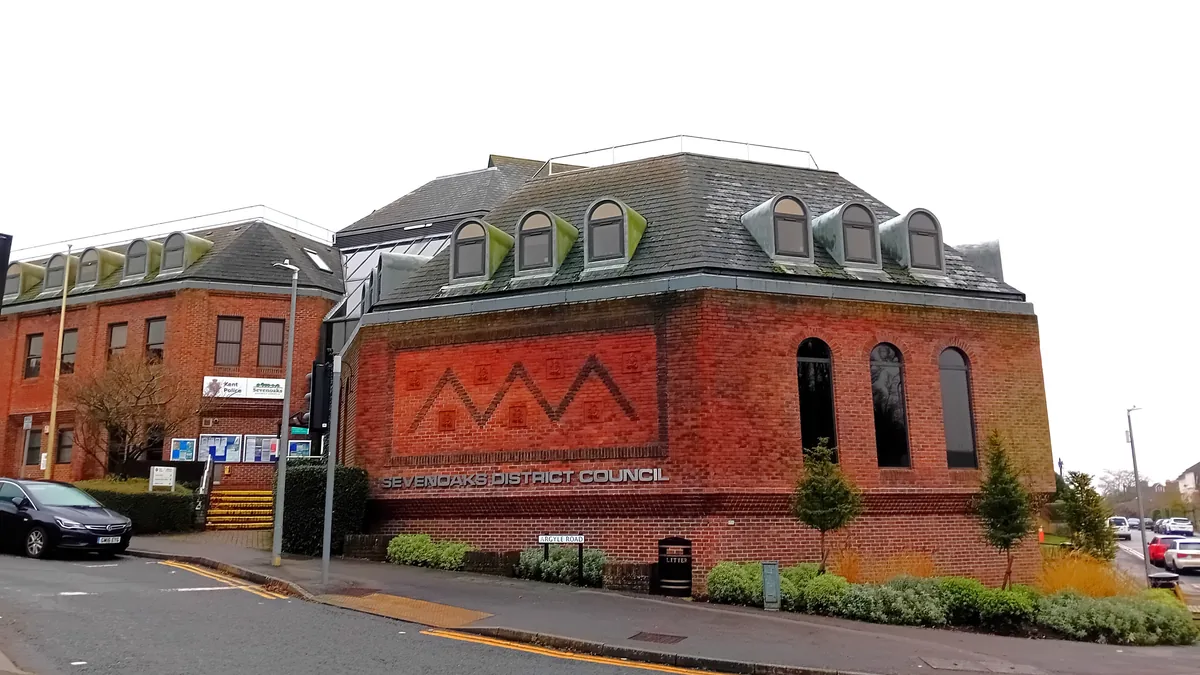

Ministers paused the scrapping of Sevenoaks District Council on 7 September and told it to stop implementation work. The May 2027 election now goes ahead.
This story was first published on 17 July 2026, when ministers decided that Sevenoaks District Council would close in April 2028. On 7 September 2026 the Government paused its reorganisation programme: four decisions taken in March were withdrawn outright, and the 14 taken in July, Kent and Medway's among them, went into a review with no published end date. Kent's councils have been told to stop implementation work. The report below has been updated throughout.
The abolition of Sevenoaks District Council is on hold. On 7 September 2026 the Government paused its local government reorganisation programme, told councils in Kent and Medway to stop work on the four new unitary authorities announced in July, and confirmed that elections due in May 2027 will go ahead to the council boundaries that exist now. The district council’s own reorganisation page records it plainly: “On 7 September 2026, Government Ministers announced that local government reorganisation would be paused.” (Sevenoaks District Council, Local Government Reorganisation)
Nothing has been cancelled. The July decision, that Sevenoaks District Council would close in April 2028 and its services pass to a new West Kent unitary covering Sevenoaks, Tonbridge & Malling, Tunbridge Wells and Maidstone, has not been withdrawn. It has been put into a review instead, alongside 13 others taken the same month, with no date given for when it reports. (MHCLG, Local government reorganisation programme review and decisions withdrawal: letter to council leaders, 7 September 2026)
What the pause changes
The letter came from Jim McMahon, the local government minister, and says the review “will look at the programme as a whole and this will include reviewing the 14 decisions made in July”. Councils were asked to “cease work on implementing the decisions that were announced in July”, and the minister wrote that “now is the time to pause and reflect”. Four areas decided back in March, Essex, Hampshire, Norfolk and Suffolk, had their decisions withdrawn altogether, which the letter puts down to updated legal advice. (MHCLG, letter to council leaders, 7 September 2026)
Three things follow for Sevenoaks.
April 2028 is no longer a date to plan around. The new councils could only be created by a Structural Changes Order laid before Parliament, and the work that would have led to one has stopped. Sevenoaks District Council continues to run every service it runs today, with no end date attached to it.
The May 2027 election is back on, and it is for Sevenoaks District Council. The letter states that “elections scheduled to take place in May 2027 will go ahead to existing council boundaries”. Under the July decision those polls would have chosen the first councillors of the West Kent authority and district councillors’ terms would have been extended instead. The Local Government Boundary Commission’s review of the district’s wards, which concluded in October 2024 that Sevenoaks should have 48 councillors, was itself paused for reorganisation and has not restarted, so the wards fought in May 2027 look like being today’s. (Local Government Boundary Commission for England, Sevenoaks)
Nobody has been given a timetable. Kent’s council leaders said in a joint statement on the day that they “will be seeking clarity from the government on a number of issues”, adding: “In the meantime, we remain 100% focused on delivering the best possible services for those who live, work and study in the county.” Sevenoaks District Council says the same in its own words, that it remains “focused on delivering the best possible services to our residents” while it waits for further guidance. (Kent councils’ response to Local Government Reorganisation review, 7 September 2026; Sevenoaks District Council, Local Government Reorganisation)
The decision that is now under review
Everything from here describes the decision taken on 16 July, which still stands on paper but which councils have been told to stop acting on. It came in a letter from Steve Reed, then the Housing Secretary, to council leaders across Kent and Medway, and it would have been the biggest change to local government in the district in more than 50 years: Kent County Council, Medway Council and all 12 district, borough and city councils, Sevenoaks among them, replaced by four councils each running every local service in its patch. (MHCLG, decision letter, 16 July 2026; Sevenoaks District Council, Ministers decide future shape of Kent and Medway’s councils, 16 July 2026)
Five rival proposals went to ministers last November. Mr Reed picked what his letter calls “the four unitary proposal submitted by Dover District Council, Swale Borough Council and Thanet District Council”, the option local outlets have been calling Option 4b. (MHCLG, decision letter, 16 July 2026; Kent Online, Kent to have four new unitary councils)
The four new councils would have covered the areas of:
- West: Maidstone, Sevenoaks, Tonbridge and Malling, and Tunbridge Wells
- North: Dartford, Gravesham and Medway
- Mid: Ashford, Folkestone and Hythe, and Swale
- East: Canterbury, Dover and Thanet
Sevenoaks sits in the West grouping, which is the pairing the district council itself had argued for. (MHCLG, decision letter, 16 July 2026)
The Secretary of State said his chosen option “performed particularly well in supporting housing delivery, alignment with functional economic areas, public sector boundaries as well as place-based and locally responsive public services”. West Kent, his letter says, “is a hub for professional services, life sciences and creative industries with vibrant town centres and strong residential markets”. (MHCLG, decision letter, 16 July 2026)
He rejected the rival plan for one giant council covering the whole county, citing “significant concerns about the size of the proposed new council, which would have a very large population at over 1.9 million, far exceeding the 500,000 guiding principle referred to in the invitation and by far the biggest council in the country”. That proposal, he concluded, “did not meet the criteria”. (MHCLG, decision letter, 16 July 2026)
Two of the four new councils will have populations below the Government’s own 500,000 benchmark. Mr Reed said that figure “has, however, always remained a guiding principle, not a fixed threshold”, and that both will be close to it. (MHCLG, decision letter, 16 July 2026)
What the new council would have run
The West Kent council would have done everything Sevenoaks District Council does now and everything Kent County Council does here as well. The district council lists the combined job as “education, social services, highways, libraries, emptying bins, leisure centres and housing services”, run the way Medway Council already operates as a single-tier authority. (Sevenoaks District Council, Ministers decide future shape of Kent and Medway’s councils, 16 July 2026)
In practice that would end the split residents have to keep track of now, bins and planning and council tax bills from Sevenoaks in Argyle Road, schools and roads and social care from County Hall in Maidstone. One council would answer for all of it.
Mr Reed also pointed to “neighbourhood area committees” as a reason for his choice, saying they “create clear neighbourhood level structures and empowerment” and could let communities “shape their own local priorities”. He argued this matters particularly in Kent, “where communities vary significantly between urban, rural and coastal areas”. How those committees would work in the Sevenoaks district’s towns and villages was never set out. (MHCLG, decision letter, 16 July 2026)
The timetable, and what is left of it
Nothing was ever going to happen immediately. The new councils could not be created until Parliament approved a Structural Changes Order, which the letter says is “required to abolish existing councils, establish new structures and make transitional arrangements”. Officials were due to write to chief executives with the implementation timeline. That order was never laid, and the implementation work has now been stopped. (MHCLG, decision letter, 16 July 2026)
Two dates were set. Elections to the new unitary councils were to be held in May 2027, and those polls, the July letter said, “will replace any scheduled local elections, and affected councillors will have their terms extended”. The new councils would then have taken over on 1 April 2028. Neither date now stands: September’s letter puts the May 2027 elections back on existing boundaries, and gives no replacement for April 2028. (MHCLG, decision letter, 16 July 2026; Sevenoaks District Council, Ministers decide future shape of Kent and Medway’s councils, 16 July 2026)
That is the part the September pause reverses. The next time Sevenoaks residents vote in a local election, expected in May 2027, they will be electing councillors to Sevenoaks District Council after all.
On money, the Government had announced £63 million in capacity funding across the reorganising areas, with £900,000 of transition support for each new unitary, up to £150,000 more per unitary for leadership in children’s services, adult social care and public health, and up to £1 million overall for areas with complicated fire and rescue transitions. Mr Reed said the effect is “more than £1 million per new unitary created”. (MHCLG, decision letter, 16 July 2026)
What the councils said in July
Cllr Kevin Maskell, Leader of Sevenoaks District Council, welcomed the outcome. “This decision marks a new beginning for the Sevenoaks District and West Kent,” he said. “Bringing together four district and borough areas to create a new West Kent Unitary Council is the model we have consistently supported for striking the right balance between strong, resilient services and maintaining a clear local focus.” (Sevenoaks District Council, Ministers decide future shape of Kent and Medway’s councils, 16 July 2026)
In a joint statement, the Kent and Medway leaders sought to calm residents worried about disruption. “We want to reassure our residents that not one of our services will change overnight, you will still be dealing with the same council staff tomorrow and the day after that,” they said. “The new councils will not come into being until 1 April 2028.” (Sevenoaks District Council, Ministers decide future shape of Kent and Medway’s councils, 16 July 2026)
Announcing the wider shake-up, which covers 14 areas of England, Mr Reed said: “We’re shaking up local government so that people get the services they deserve, cleaner streets, better care, and money spent on what matters most to local people.” (MHCLG, 14 more areas to benefit from streamlined local services, 16 July 2026)
The decision followed a Government consultation that drew around 3,000 responses. (Sevenoaks District Council, Ministers decide future shape of Kent and Medway’s councils, 16 July 2026)
What it means for you
Nothing changes, and now there is no date on which it would. Your bin day, your council tax bill, your planning application and the officers you deal with all stay exactly as they are. Sevenoaks District Council continues to run its services, set its budget and take planning decisions, and it will be doing so through the May 2027 election and beyond. Our guides to bin collection days, council tax bands and planning applications all still apply.
The open questions have not gone away, they have just lost their deadline. Council tax is one: the four West Kent districts charge different amounts, and reorganisations elsewhere have had to harmonise bills over a number of years, with nothing published on how that would work here. The other is the work Sevenoaks is doing now that a successor would inherit, including the emerging Local Plan, whose consultation closes on 17 September, and the Land East of the High Street regeneration with its loan of up to £40 million. Both were being weighed against a 2028 handover that no longer has a date, which is its own argument for watching what Argyle Road commits to next.
If you want to follow it, the district council keeps a page for reorganisation at sevenoaks.gov.uk/lgr, which now carries the pause, and both letters are published in full on GOV.UK. The July decision letter was copied to council chief executives, Kent’s MPs and the Kent and Medway Police and Crime Commissioner. (MHCLG, decision letter, 16 July 2026)
Sources
- MHCLG, Local government reorganisation programme review and decisions withdrawal: letter to council leaders, 7 September 2026
- Sevenoaks District Council, Local Government Reorganisation
- Kent councils’ response to Local Government Reorganisation review, 7 September 2026
- Local Government Boundary Commission for England, Sevenoaks electoral review
- Ministry of Housing, Communities & Local Government, Local government reorganisation: decision letter to Kent and Medway council leaders, 16 July 2026 (PDF)
- MHCLG, Local government reorganisation: decision letters to council leaders
- MHCLG, 14 more areas to benefit from streamlined local services, 16 July 2026
- Sevenoaks District Council, Ministers decide future shape of Kent and Medway’s councils, 16 July 2026
- Kent Online, Local Government Reorganisation: Kent to have four new unitary councils
Image: Sevenoaks District Council Offices by Richard Kelly, CC BY 4.0, via Wikimedia Commons.
Have your say